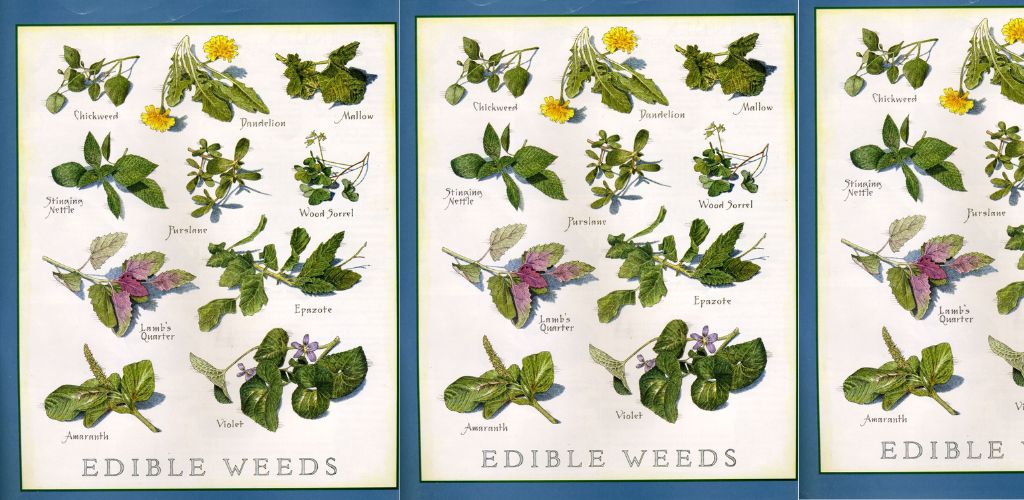
Wussten Sie, dass einige Unkräuter, um die wir uns in unseren Höfen und Gärten immer Sorgen machen, tatsächlich gut für Sie sind und bei richtiger Zubereitung köstlich sein können? Achten Sie darauf, die Unkräuter richtig zu identifizieren (die hier beschriebenen sind leicht zu erkennen). Vermeiden Sie die Ernte an Orten, an denen Sie eine Verschmutzung vermuten – etwa durch Fahrzeugabgase, Rasenpestizide oder Hundegeschäfte. Und denken Sie daran, dass essbar nicht gleichbedeutend mit allergenfrei ist. Hier sind 9 gute:
LÖWENZAHN
Löwenzahn ist eines der gesündesten und vielseitigsten Gemüsesorten der Welt. Die gesamte Pflanze ist essbar. Die Blätter sind wie Vitaminpillen und enthalten großzügige Mengen an Vitamin A, C und K – weit mehr als diese Gartentomaten – sowie Kalzium, Eisen, Mangan und Kalium.
Die Blätter sind am zartesten und leckersten, wenn sie jung sind. Dies geschieht im Frühjahr, aber auch den ganzen Sommer über, wenn die Pflanze nach dem Schneiden oder Ziehen versucht, sich zu erholen. Sie können sie in großer Menge zur Suppe hinzufügen. Oder Sie bereiten sie auf italienische Art zu, indem Sie sie mit etwas Olivenöl, Salz, Knoblauch und etwas scharfer roter Paprika anbraten.
Die hellen, offenen Blütenköpfe können Sie in einem leicht frittierten Teig essen. Sie können aus den Blüten auch einen einfachen Wein herstellen, indem Sie sie mit Rosinen und Hefe fermentieren. Wenn Sie etwas abenteuerlustiger sind, können Sie die Löwenzahnwurzel rösten, mahlen und wie Kaffee aufbrühen. Es ist ein erworbener Geschmack. Vielleicht möchten Sie etwas Zucker zur Hand haben.
PURSLANE
Wenn Sie jemals in der Stadt gelebt haben, haben Sie die gute alte Portulaca olearacea oder den Portulak gesehen. Das Zeug wächst in Ritzen im Gehweg. Abgesehen davon, dass Portulak für Crack-Liebhaber überraschend lecker ist, steht Portulak auch ganz oben auf der Liste der Pflanzen mit Omega-3-Fettsäuren, der Art von gesundem Fett, das im Lachs vorkommt.
Wenn Sie den bitteren Geschmack von Löwenzahngrün nicht mögen, gefällt Ihnen vielleicht trotzdem der zitronige Geschmack von Portulak. Die Stängel, Blätter und Blüten sind alle essbar; und sie können roh auf Salaten gegessen werden – wie sie weltweit zubereitet werden – oder leicht angebraten.
Vor der Ernte sollten Sie jedoch einige Dinge beachten. Achten Sie auf Wolfsmilch, einen ähnlich aussehenden Bewohner von Gehwegspalten. Wolfsmilch ist viel dünner als Portulak und enthält einen milchigen Saft, sodass man ihn leicht unterscheiden kann. Vielleicht hat dich deine Mutter auch davor gewarnt, Dinge vom Bürgersteig zu essen; Suchen Sie stattdessen nach Portulak, der in Ihrem Garten wächst, oder erwägen Sie, ihn von einem Gehweg aus in Ihren Garten zu verpflanzen.
Beachten Sie auch, dass manche Leute Portulak fälschlicherweise „Ackerkraut“ nennen, aber das ist ein anderes Unkraut – essbar, aber nicht so lecker.
LAMMVIERTEL
Lammviertel sind wie Spinat, nur dass sie gesünder, schmackhafter und einfacher anzubauen sind. Im Gegensatz zu Löwenzahn oder Portulak braucht der Gänsefuß, auch Gänsefuß genannt, meist mehr als eine Gehwegspalte, um darin zu wachsen. Dennoch sind sie im gesamten Stadtgebiet überall dort zu finden, wo etwas Schmutz vorhanden ist.
Der beste Teil des Lammviertels sind die leicht samtigen Blätter mit einem feinen weißen Puder auf der Unterseite. Entsorgen Sie alle toten oder erkrankten Blätter, bei denen es sich normalerweise um die älteren Blätter an der Unterseite der Pflanze handelt. Die Blätter und jüngeren Stängel lassen sich schnell kochen oder sautieren und schmecken wie eine Kreuzung aus Spinat und Mangold mit einem leicht nussigen Nachgeschmack.
Vielleicht gefällt Ihnen diese Geschmackskombination nicht, aber Lammviertel sind unglaublich gesund. Mit einer Portion von einer Tasse erhalten Sie das Zehnfache der empfohlenen Tagesdosis an Vitamin K; dreimal so viel Vitamin A; mehr als genug Vitamin C; und die Hälfte Ihrer täglichen Dosis an Kalzium und Magnesium.
PLANTAIN
Plantain, like dandelion, is a healthy, hardy weed as ubiquitous in the city as broken glass. You know what it looks like, but you might not have known the name.
Part of the confusion is that plantain shares its name with something utterly different, the banana-like plantain, whose etymology is a mix of Spanish and native Caribbean. The so-called weed plantain, or Plantago major, was cultivated in pre-Columbus Europe; and indeed Native Americans called it “the white man’s footprint,” because it seemed to follow European settlers.
Plantain has a nutritional profile similar to dandelion — that is, loaded with iron and other important vitamins and minerals. The leaves are tastiest when small and tender, usually in the spring but whenever new shoots appear after being cut back by a lawnmower. Bigger leaves are edible but bitter and fibrous.
The shoots of the broadleaf plantain, when green and tender and no longer than about four inches, can be described as a poor-man’s fiddlehead, with a nutty, asparagus-like taste. Pan-fry in olive oil for just a few seconds to bring out this taste. The longer, browner shoots are also tasty prepared the same way, but the inner stem is too fibrous. You’ll need to place the shoot in your mouth, clench with your teeth, and quickly pull out the stem. What you’re eating are the plantain seeds.
The leaves of the equally ubiquitous narrow-leaf plantain, or Plantago lanceolata, also are edible when young. The shoot is “edible” only with quotation marks. You can eat the seeds should you have the patience to collect hundreds of plants for the handful of seeds you’d harvest. With time being money, it’s likely not worth it.
CHICKWEED
One of the not-so-ugly weeds worth pulling and keeping is chickweed. Identified by purple stems, fuzzy green leaves, and starry white flower petals, this weed is a fantastic source of vitamins A, D, B complex, and C. It also contains minerals like iron, zinc, calcium, and potassium. Chickweed (Stellaria media) has a cornsilk-like flavor when eaten raw, and tastes similar to spinach when it is cooked. [1]
Chickweed nourishes the lymph and glandular systems, and can heal cysts, fevers, and inflammation. It can help neutralize acid and help with yeast overgrowth and fatty deposits, too.
Additionally, chickweed can be finely chopped and applied externally to irritated skin. Steep the plant in ¼ cup of boiling water for 15 minutes, and chickweed provides benefits similar to dandelion root. Speaking of dandelion…
CLOVER
Other than the occasional four-leafed clover hunt, this common lawn weed goes mostly unnoticed, even though it is becoming popular as a lawn replacement altogether. Clover is an important food for honeybees and bumblebees, and clover leaves and flowers can be used to add variety to human meals as well. Small amounts of raw clover leaves can be chopped into salads, or can be sauteed and added to dishes for a green accent, and the flowers of both red and white clover can be eaten raw or cooked, or dried for tea.
MALLOW
Mallow, or malva, is also known as cheeseweed, due to the shape of its seed pods, and can be found in many lawns or garden beds across the US. The leaves and the seed pods (also called the ‘fruit’) are both edible, either raw or cooked, and like many greens, are often more tender and palatable when smaller and less mature. The older leaves can be used like any other cooked green after steaming, boiling, or sauteing them.
WILD AMARANTH
The leaves of the wild amaranth, also known as pigweed, are another great addition to any dish that calls for leafy greens, and while the younger leaves are softer and tastier, the older leaves can also be cooked like spinach. The seeds of the wild amaranth can be gathered and cooked just like store-bought amaranth, either as a cooked whole grain or as a ground meal, and while it does take a bit of time to gather enough to add to a meal, they can be a a good source of free protein.
STINGING NETTLES
It sounds like a cruel joke, but stinging nettles — should you be able to handle them without getting a painful rash from the tiny, acid-filled needles — are delicious cooked or prepared as a tea.
You may have brushed by these in the woods or even in your garden, not knowing what hit you, having been trained all your life to identify poison ivy and nothing else. The tiny needles fortunately fall off when steamed or boiled. The trick is merely using garden gloves to get the nettles into a bag.
Brennnesseln schmecken ein wenig wie Spinat, nur aromatischer und gesünder. Sie sind vollgepackt mit essentiellen Mineralien, die Sie außerhalb einer Multivitaminflasche nicht zusammen finden, darunter Jod, Magnesium, Kalium, Phosphor, Kieselsäure und Schwefel. Brennnesseln enthalten außerdem mehr Protein als die meisten Pflanzen.
Sie können die Blätter essen und das Wasser dann als Tee trinken, mit oder ohne Zucker, heiß oder kalt. Wenn Sie abenteuerlustig sind, können Sie ganze Pflanzen zum Trocknen in Ihrem Keller sammeln. Mit der Zeit fallen die Nadeln ab und Sie können die getrockneten Blätter den ganzen Winter über für den Tee aufbewahren. Infos von Christopher Wanjek